

Ithaca Falls Natural Area
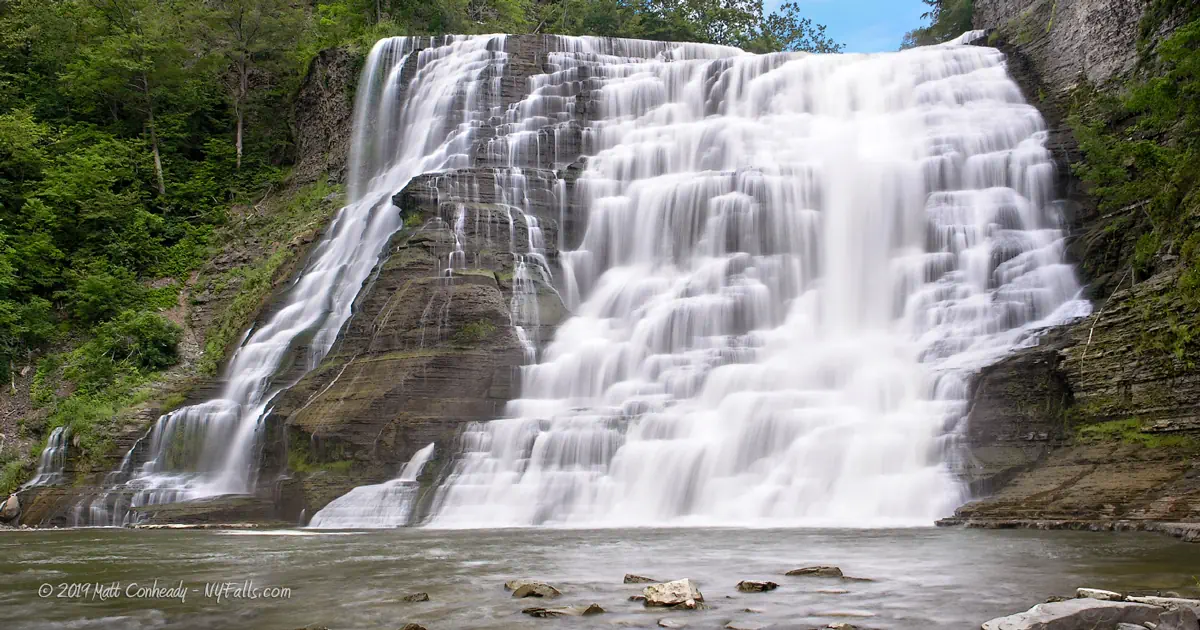


Location: On the south end of Cayuga Lake; In the city of Ithaca, Tompkins County, New York.
Maps: Google Map, Topographic; Interactive map
GPS Coordinates:
- Ithaca Falls: N 42.45282 / W 76.49170
- Parking area: N 42.45234 / W 76.49420
- Gun factory smokestack: N 42.45206 / W 76.49344
Directions:
- From NY-13 in Ithaca, take Seneca St east to Stewart Ave.
- Take a left (north) on Stewart and follow it into the Cornell University Campus.
- Turn left onto University Ave and cross into Lake St. Lake turns left, then right.
- You will be able to see Ithaca Falls on the right, but that also means you passed the parking area.
Or use Google Maps.
Parking: There are two small lots up on a hill just south of where Lake St crosses Fall Creek. If those are full, you can probably park in the lot at the high school across the street and to the north (assuming it is not in session).

Weather
Information / Accessibility / Accommodations
Warning: This area is classified as a Superfund Site, and is contaminated with lead from the former Ithaca Gun factory that was adjacent to the falls. The soil in this gorge is contaminated with lead and if you come in contact with the soil, rocks, water, you are putting yourself at risk of lead-related illness. Despite the clean-up efforts, a survey in 2018 found the soil to have high levels of lead. In response, the trail has been covered with gravel. If you go off the trail, you are on said contaminated soil. For more information, see this article. Yeah, most people ignore the warning signs and have their kids and pets playing all over the rocks. Don’t be one of those people.
Number of falls: 1. There are additional waterfalls close by. Check out Fall Creek Gorge for information.
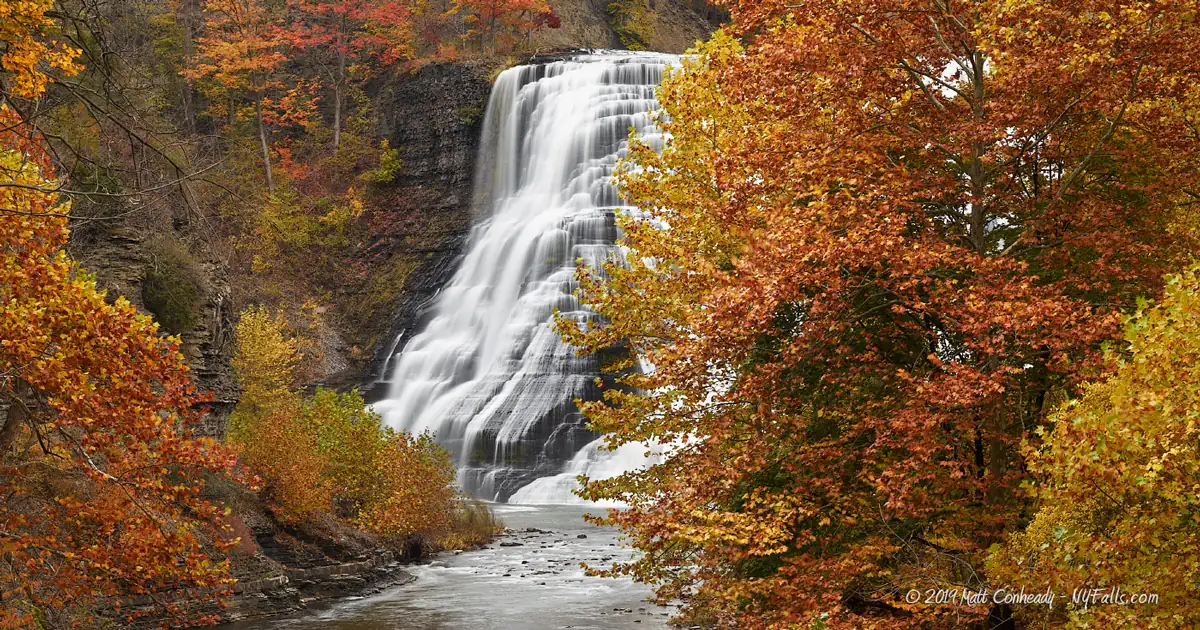
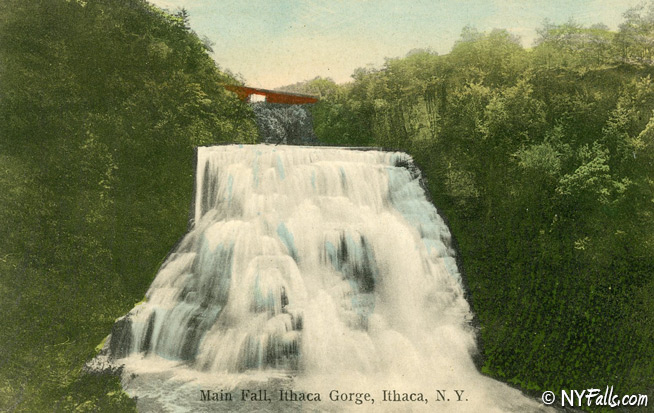
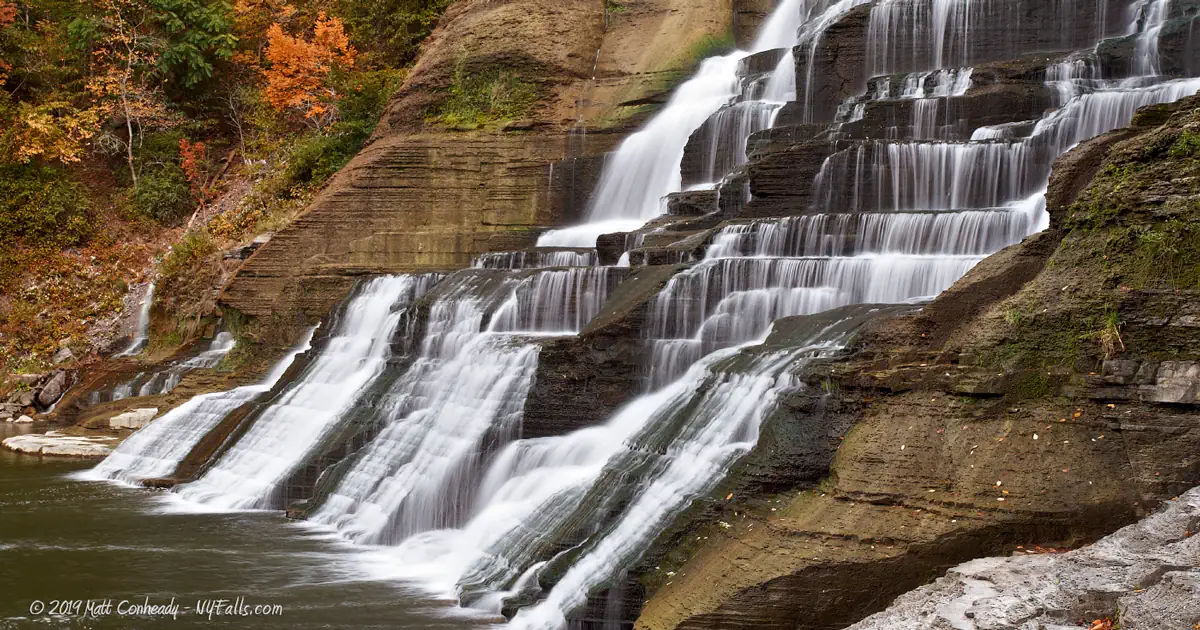
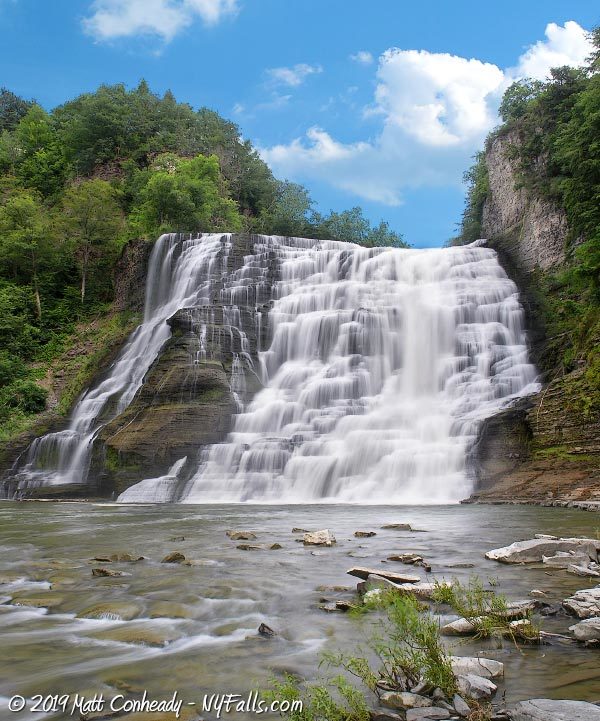
Size/Types: Ithaca Falls is a massive jumble of irregular cascades and a few overhanging drops. It is 150 feet high and 175 feet wide. The top has a small dam, a remnant from when the falls was used to generate power. The dam is estimated at 10 ft high.
Best time to visit: Year-round.
Flow: Moderate to high. Fall Creek can get nasty during spring. Swimming, which is prohibited, can be deadly.
Waterway: Fall Creek starts nearly 8 miles northeast near Fillmore Glen State Park and Summer Hill State Forest. It begins cutting into what is called Ithaca Gorge about 3 miles east of here, creating sheer cliff and diamond-shaped fractures along its stretch. It drops over several man-made dams on its way to the Cornell campus where it is dammed to create Beebe Lake. It then tumbles over 6 natural falls on its way to Ithaca Falls. It passes through a residential section of the city, then Stewart Park and into Cayuga Lake.
Time: You can see half of the falls by just driving by, but if you would like to get the full view, set aside at least 15 minutes to walk up to the falls.
Seasons/Hours: The Natural Area is usually open, but during unusually high water flow, you may not be able to get close to the falls.
Parking: There are two small lots up on a hill just south of where Lake St crosses Fall Creek. If those are full, you can probably park in the lot at the high school across the street and to the north (assuming it is not in session).
Admission: Free.
Handicap accessibility: From the sidewalk on the Lake St bridge.
Pets: Allowed if on a leash. For your pet’s safety, and the safety of other hikers, keep your pet on the leash. It doesn’t matter if your dog is “friendly,” it’s the law. Pets can get seriously injured or knock someone into the gorge. Pets are not allowed in the water (strong, dangerous currents).
Swimming: Prohibited and dangerous.
Accommodations: Benches, trail.
Description
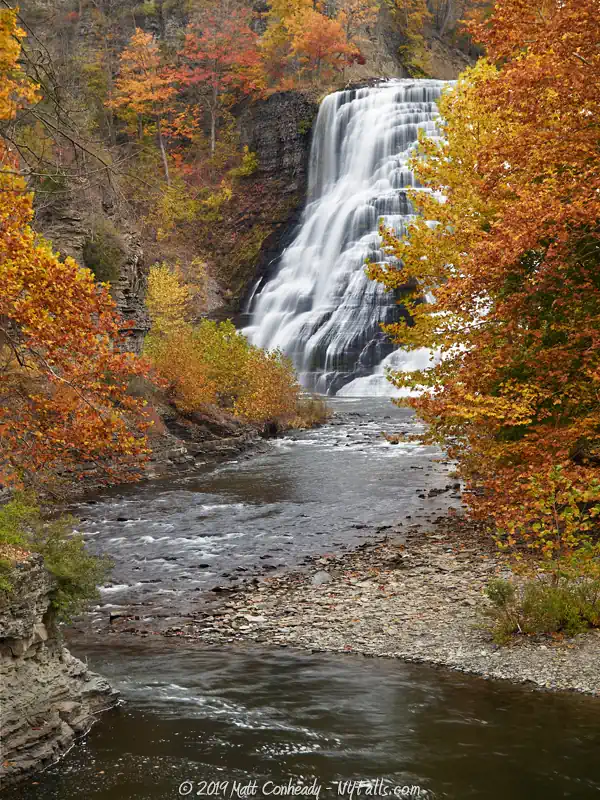
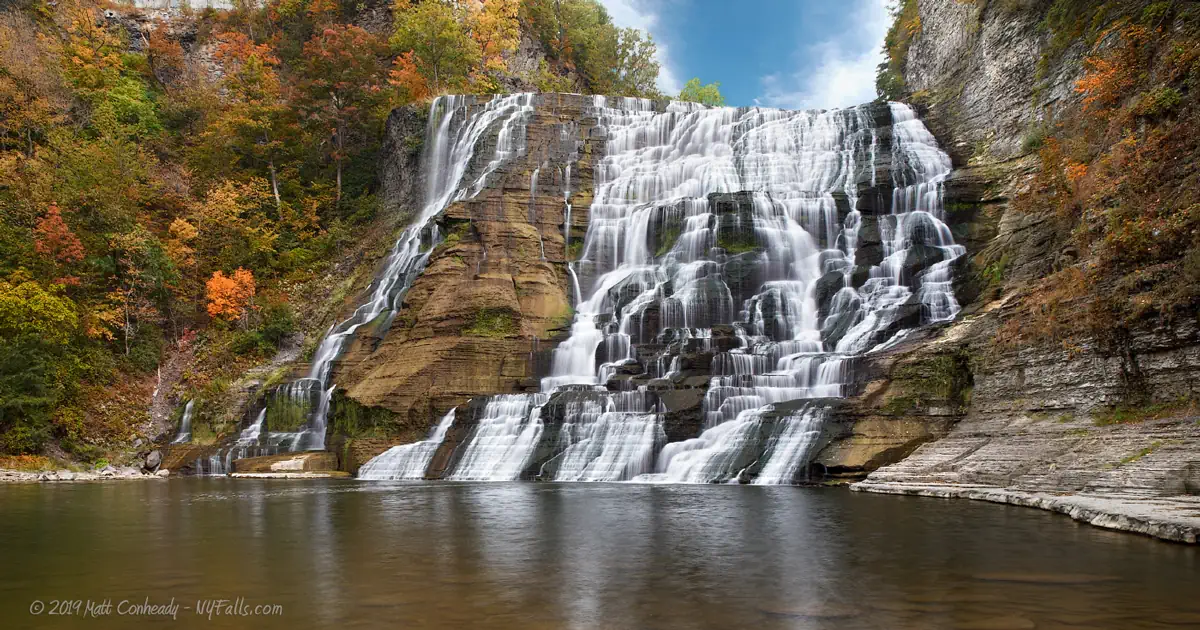
Ithaca Falls is most definitely the symbol of Ithaca, New York, a city settled within the crossroads of deep gorges, bordered by acclaimed colleges, and rife with manufacturing history. The waterfall itself is massive. Towering over 100 feet tall and stretching nearly 175 ft across at its base, it can fill the adjacent neighborhood and Cornell’s western flank with a thunderous springtime roar. By autumn, the frothy cascade slows and students take to the banks to read or practice photography among the turning leaves. This gem, like most urban waterfalls, was once exploited and nearly jeopardized by industrial pollution, but is now protected and open for the public to enjoy.
With towering sheer cliffs bordering the falls, the recently designated “Natural Area” that houses Ithaca Falls is an unexpected oasis within the city limits. Driving for your first time through Ithaca, and passing the waterfall, you almost don’t believe what you see. In a single day, easily a hundred drivers will tap their brakes as they travel down Lake St, doing a double-take as they pass the falls. Those that have the time, get out and take the brief walk up to the falls. It’s quick and easy to see, as well as breathtaking when the water level is high and the water is violent.
Occasionally the irresistible sound of the plummeting water and the massive plunge pool below will attract swimmers. Not a good idea. Fall Creek’s nearly 20 miles of watershed feeds Ithaca Falls with unpredictable currents that have already claimed the lives of several. Even when flow is moderate, the foamy water it stirs up can easily overcome a swimmer, and the froth makes visibility difficult.
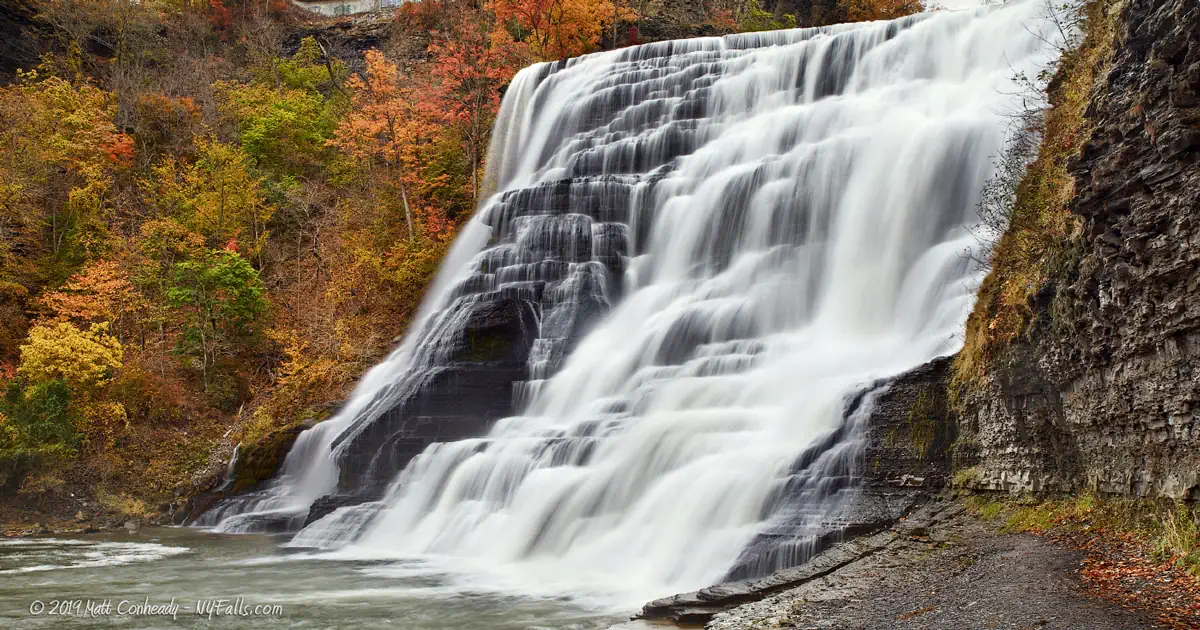
There is a balance that must be struck at Ithaca Falls. It is accessible; probably one of the easiest, for its size, to get to in the Finger Lakes. It is also picturesque and takes on a new personality every season. In spring it gushes with power, while summer brings low flow—breaking up the cascade into sections and enhancing the character of the rock-face. Fall color is a must-see, while the ice formations in winter can be colossal. It is a beautiful sight for gazes and cameras year-round, and it is comforting to be in its presence. Visitors must keep in mind the dangers and not underestimate the power held within the falling waters (or rocks). Ithaca Falls is open to the public by the city to be seen and experienced with caution.

History
 The settlement that became Ithaca was founded on the flat at the south end of Cayuga Lake, a glacial lake formed by the deep gouging of the limestone bedrock by numerous massive glaciers. The lake’s rock basin actually extends to the face of Ithaca Falls and the flat, in which the majority of the present city lies, is within the lake basin. Glacial rock and mud debris filled the south end thousands of years ago, creating the flat, and allowing the lake’s rocky outline to surround the city, jutting out in the landscape and eroding over time to create several massive gorges.
Prior to pioneer settlers, the Cayuga Indians claimed the Ithaca area as hunting ground (the most well-known hunting camp being at the entrance to Cascadilla Gorge), only to be driven away during the American Revolution’s Sullivan Campaign. After the American Revolutionary War, much of what is now Upstate New York was divided up to pay soldiers for their efforts. The settlement at Ithaca (then called Ulysses) continued to grow, boosted by the opening of the Erie Canal and then the Owego Railroad. As a manufacturing hub of the state, businesses in Ithaca cranked out industrial and commercial products, such as transmission hardware, appliances, and car parts.
In 1865, Cornell University was founded and the city’s shift towards the education industry began. Many of Ithaca’s present day landmarks are named after prominent Cornell and Ithaca College scholars, and many of the gorges and park properties at some point were acquired by these institutions or their alumni.
For a brief time the silent film industry began to take hold with at least one studio taking advantage of the dramatic landscape and accessibility Ithaca offered. Several films featured the waterfalls and cliffs of Ithaca’s popular gorges. Eventually filmmakers made their base in Hollywood instead.
 The Ithaca Gun Company began large-scale manufacturing of sporting shotguns and rifles in 1880. Their factory was a milling and machining complex situated over a small ravine next to Ithaca Falls. The company dammed the top of the falls and a large raceway diverted flow from Fall Creek through the factory’s turbine, down the ravine, and back into the creek. In later years, the factory upgraded from mechanical mills to turbines that directly generated electricity to power modern equipment. Ithaca Guns began its life making inexpensive Remington knock-offs, but soon began innovating and enhancing the quality of their own models. Eventually they made quite a name for themselves with repeat customers and celebrity endorsements. Through military contracts during WWI and WWII, they hit it big and expanded their operations within the city. Milling gun barrels and gears became big business in Ithaca, and many people used that expertise in designing transmission components, which soon became a booming industry within the city too.
 During its heyday, and when owning a gun in New York was more common than owning a car is today, models such as the Ithaca 37 Shotgun and Lefever rifles were household names. Eventually the need and the demand for household weaponry died down and the guns became more collector’s items than tools. Ithaca Gun was eventually bought out and manufacturing was moved to Northern Ohio. The property, including what is now the Ithaca Falls Natural area, was donated to Cornell University, which surveyed the land and found dangerous contamination of the soil and groundwater. Decades of ammunition testing and materials dumping on the factory property resulted in it being designated as a national Superfund site, primarily because of lead contamination (older munitions were made of lead). Cornell then handed the land over to the city. The EPA cleaned up the site from 2000 to 2004, and in 2006 the city condemned the old factory buildings. Recently, city and state funds have been allocated to demolish the old factory (although leaving the characteristic “Ithaca Gun” smokestack) and made way for townhomes and a small park/viewing platform (which is supposed to offer views of Cayuga Lake and Ithaca Falls). The cost of cleanup as well as the difficult geology of the site have caused many delays. We have no estimated completion date.
Hiking / Walking Trails
From the parking area to Ithaca Falls
Difficulty: Easy.
Distance: Less than a quarter mile.
Markings: Gravel trail. Soil outside of the gravel trail is contaminated with lead. Don’t go off the trail.
Description: From the parking area, follow the dirt path down to the small park near the creek. A path then runs through a small wooded area into the creek bed. You are free to explore the creek bed or continue along the right side of the gorge towards Ithaca Falls. This pathway may not be usable in times of high water flow or when conditions are icy. Proceed with caution and at your own risk.
You may also view the falls from downstream at the Lake St bridge.
Map: Interactive.
Ithaca Falls Interactive Map
Ithaca Falls Media
Ithaca Falls Audio
Ithaca Falls Video
More coming soon..
Explore More

Fall Creek Gorge
Just above Ithaca Falls are 4 beautiful waterfalls in an isolated portion of the gorge. You can get as close to them as you can Ithaca falls, and I recommend you drive to another location to start the hike, but since you are pretty close already, go for it.
Interesting Stuff
The Stewart Avenue Bridge
You cannot see Ithaca Falls from the Stewart Avenue Bridge, which crosses Fall Creek just above the falls, but you can see the dam that caps it, as well as a wonderful view across the Ithaca Valley. It’s perfect for catching sunsets as well. Look upstream to see Forrest Falls.
Fences
The Stewart Avenue Bridge, as well as many other bridges over gorges in Ithaca, have been encapsulated in wire fencing. Why? A strategy in suicide prevention. Although this makes for more difficult photography, some holes have been cut through the fences to allow lenses to poke through.
Raceway
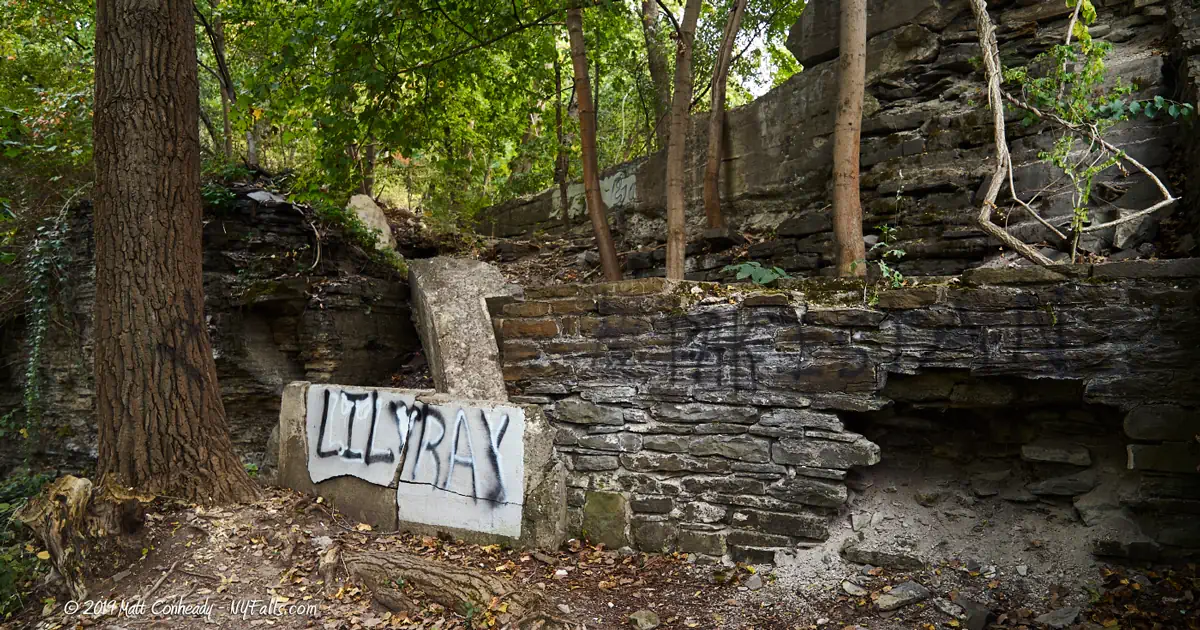
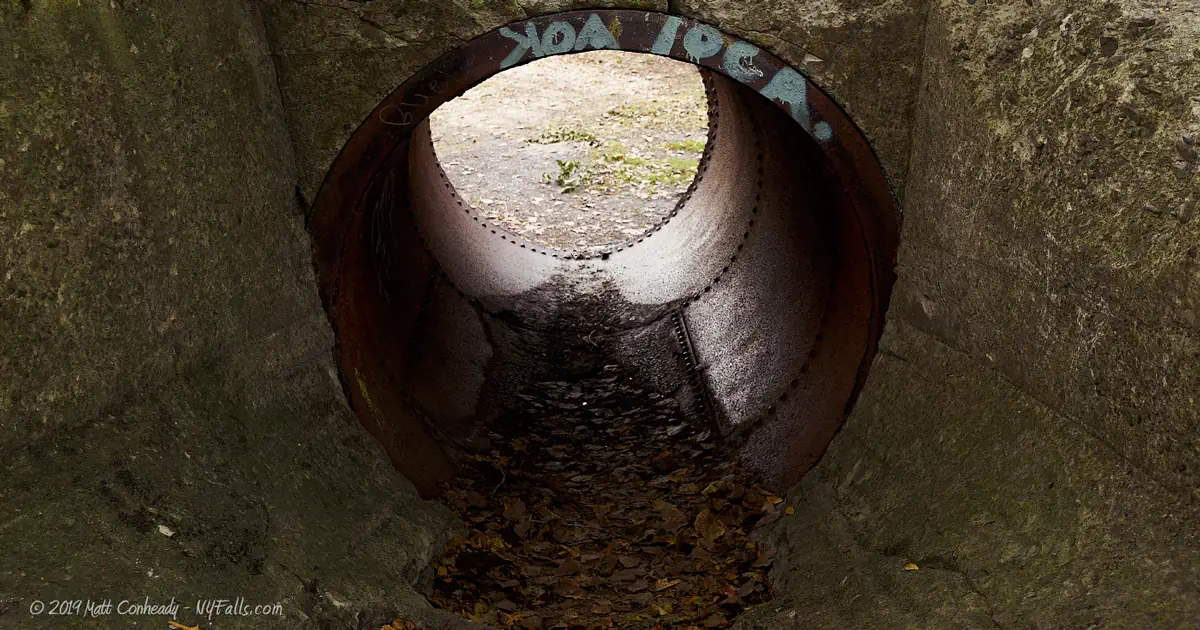
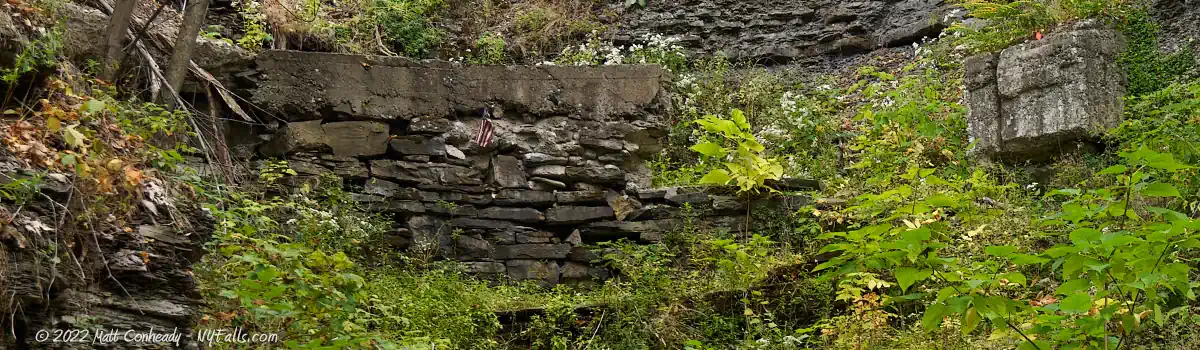
To the right of the small park near the roadside is the remains of the Ithaca Gun Factory’s raceway that carried the water that powered the plant. The run is made from concrete and leads up to the turbine house up the hill. This whole area is condemned and off limits.
Photography Tips
Zoom in
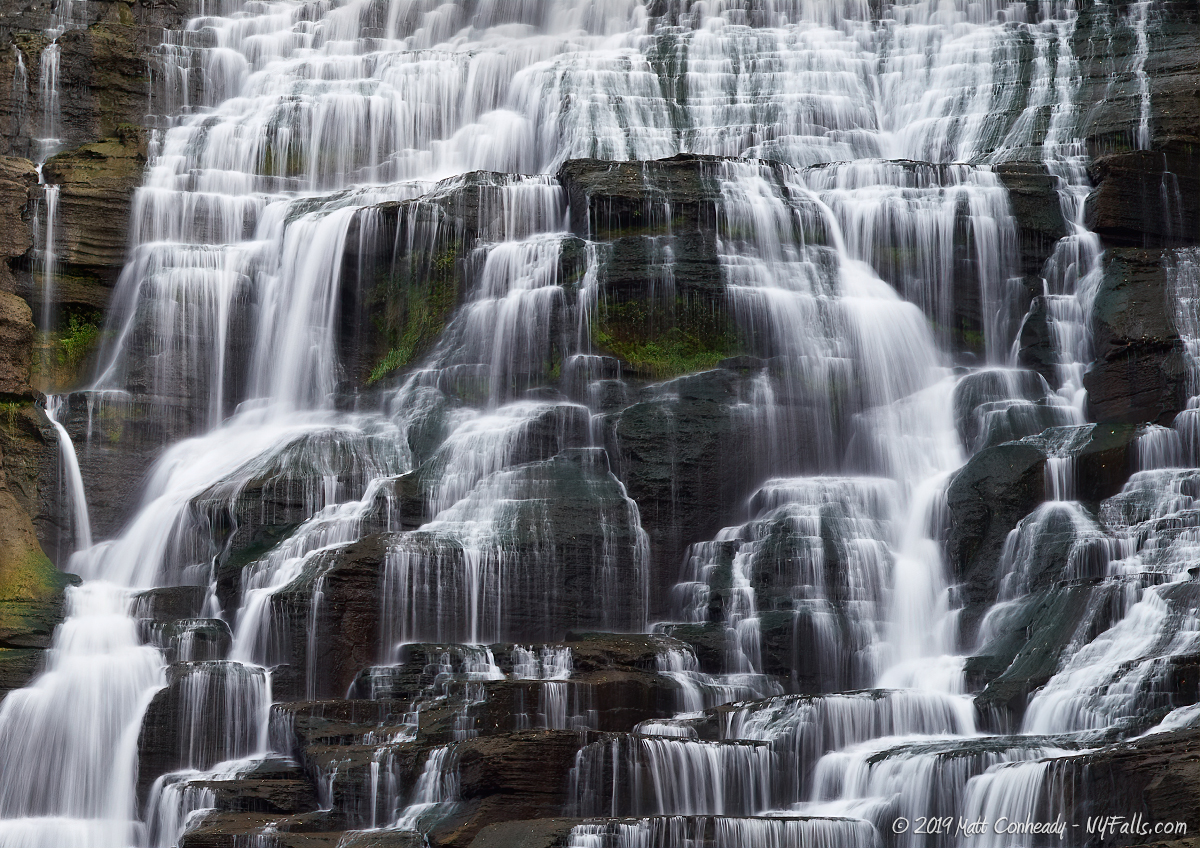
- Don’t just photograph the entire falls at once. There is so much going on with Ithaca Falls. It is like hundreds of little unique drops in one. Zoom in to specific parts to create unique photos.
Come back
- Don’t limit your photography to one season or one time of day. Ithaca Falls changes drastically over time. Come back again later.
Mist
- Be mindful of mist when shooting from the viewing platform on the eastern side. Bring a soft but absorbent lens cleaning cloth and wipe your lens frequently.
Silky Water Effect
- To get that smooth cotton-candy look to the falls, you need to use a Neutral Density (ND) filter on your lens. The ND filter will block some of the light from entering the lens without altering the color, and thus allow your shutter to stay open longer. This blurs the water and creates a soft white gloss to the foamy areas of the falls. Check out the article for the all the details.
More tips
- See the Articles for more photography tips.

10 Must-Visit Waterfalls Around Ithaca, NY
A selection of the most popular and accessible waterfalls around Ithaca in the Finger Lakes Region of New York.
Who to Contact
Ithaca Department of Public Works
Second Floor of City Hall
108 East Green Street, Room 202
Ithaca, NY 14850
Phone: (607) 274-6527
cityofithaca.org/208/Public-Works
DEC – Environmental Remediation
615 Erie Blvd. West,
Syracuse, NY 13204-2400
Phone:(315) 426-7519
dec.ny.gov
